
Luke 10:25-37
And behold, a lawyer stood up to put him to the test, saying, “Teacher, what shall I do to inherit eternal life?” He said to him, “What is written in the Law? How do you read it?” And he answered, “You shall love the Lord your God with all your heart and with all your soul and with all your strength and with all your mind, and your neighbor as yourself.” And he said to him, “You have answered correctly; do this, and you will live.”
But he, desiring to justify himself, said to Jesus, “And who is my neighbor?”
Jesus replied, “A man was going down from Jerusalem to Jericho, and he fell among robbers, who stripped him and beat him and departed, leaving him half dead. Now by chance a priest was going down that road, and when he saw him he passed by on the other side. So likewise a Levite, when he came to the place and saw him, passed by on the other side. But a Samaritan, as he journeyed, came to where he was, and when he saw him, he had compassion. He went to him and bound up his wounds, pouring on oil and wine. Then he set him on his own animal and brought him to an inn and took care of him. And the next day he took out two denarii[a] and gave them to the innkeeper, saying, ‘Take care of him, and whatever more you spend, I will repay you when I come back.’ Which of these three, do you think, proved to be a neighbor to the man who fell among the robbers?” He said,
“The one who showed him mercy.” And Jesus said to him, “You go, and do likewise.”
Introduction
Let me tell a story about a teacher who likes to arrive at school early every day. He is in his late 30 and likes to arrive early to get his class set up. Most days, it is still dark when he comes to work. In the morning, he takes the express bus downtown before taking the light rail to his final stop at Midtown station. Once he exited the train, he finishes his walk, which includes an unpleasant underpass where several homeless people are sleeping. He can smell the cheap liquor and spoiled food. Empty bottles of liquor and dollar store mouthwash are scattered around the area. Sometimes, they are awake and chatting with each other. They speak when he sees them. He waves back, of course, as he slightly picks up the pace.
This scene assumes that the weather is suitable for sleeping outside. Deep in the winter, when the wind chill can reach – 30 degrees Fahrenheit, they are usually huddled up inside the Light rail station attempting to stay warm and unnoticed.
The teacher, fully dressed for the weather, doesn’t change his disposition. He simply walks around them. He scoffed a little at the smell of liquor and body odor. Nevertheless, he never stops, but he just walks on by.
Notice that I didn’t say a specific city because this scene often takes place in many cities and towns. How many times have you walked past someone who seemed mentally distressed, drunk, poor, sad, or worried? They seldom ask for anything, but you know they need to hear that God loves them. They need to hear that they are not alone. How often have you offered that word?
Jesus tells an interesting story about the Good Samaritan, which is very interesting once you know the history and geography. When Jesus asked the lawyer which of the men proved to be a neighbor, the lawyer said the one who showed mercy. He tells him to go and “do likewise.” In this passage, Jesus tells us that everyone is our neighbor, not just the people we hold dear to us.
Now this message can be interpreted in the literary sense and be helpful to those you consider your enemy. However, I think this passage also goes into the heart of the Great Commission because Jesus expects us to spread the Gospel to those whom we may consider “undesirable” or “difficult to reach” without regard to our own comfort and safety.
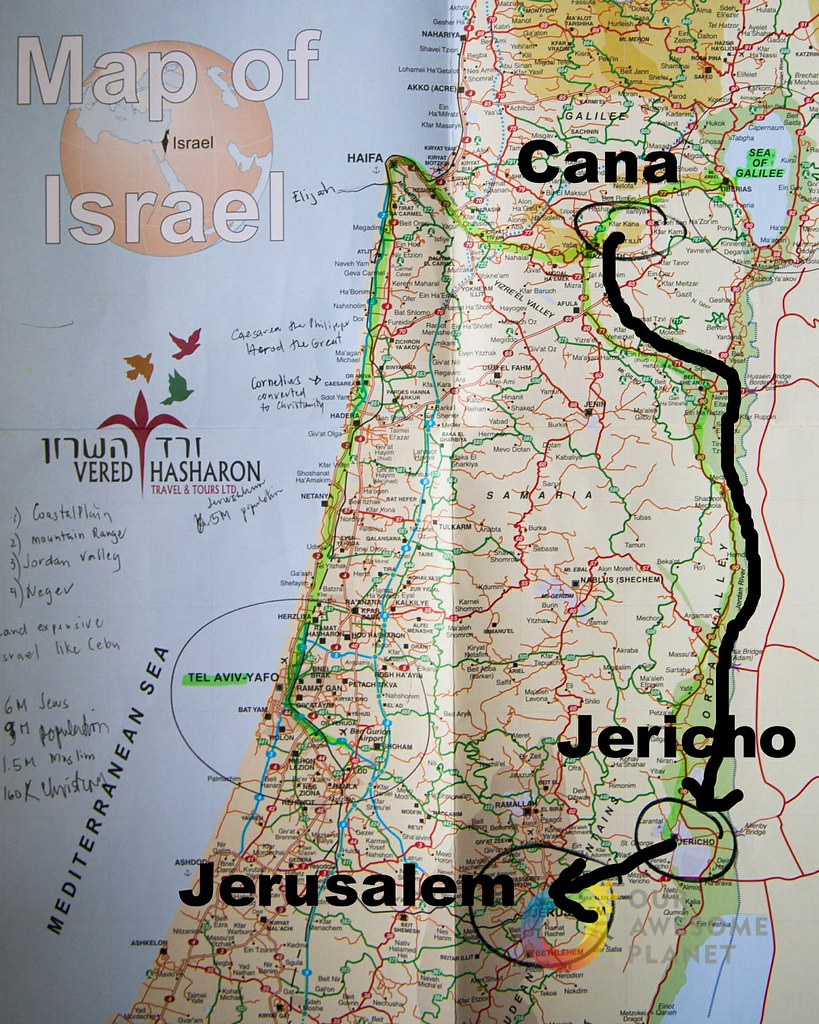
From Jerusalem to Jericho or “Way of Blood”
In this parable, Jesus especially speaks of the Jewish man going down from Jerusalem to Jericho. This travel is dangerous for two different reasons. 1.) The first reason is the geography of the area. 2.) The second reason is the high threat of being robbed.
When you start from Jerusalem, you are beginning at about 2500 feet above sea level, and you will travel to Jericho, a place that is about 864 feet below sea level. Approximately 3,400 feet (or nearly 2/3 of a mile) drop in elevation over an 18-mile period in mostly desert. The route can be very isolated. There was a safer route by way of Samaria, but the Jewish man would not take that route because he didn’t want to go through Samaria, but we will get into that a little later.
Now when you are on this journey from Jerusalem to Jericho, the path is mostly isolated. Moreover, there are a lot of convenient hiding places for robbers to hide. This journey was notorious for robbers attacking pilgrims between Jerusalem and Jericho. In fact, this area was known as the “Way of Blood” because so many people were robbed and killed during their travel.
The geography of this route was and is very treacherous to this very day. Jesus knew that this route was dangerous because he traveled to Jerusalem via Jericho at least once during his ministry (Mark 10:46-11:7).
Politics – Jewish and Samaritan
Now, why would the Jewish traveler go to Jericho by way of Jerusalem when he knew how dangerous that route is? As I said before, there was a safer way to get to Jericho by way of Samaria. Well, most Jewish people, at the time, would instead put their life in danger rather than step foot in Samaria.
See, Samaritans and the Jewish people had a long history of dislike towards each other. The nations started as brothers from the same father of Jacob (or Israel). However, after Solomon’s death, the united kingdom of Israel broke up. The ten tribes occupied the Northern part, and Judah and Benjamin occupied the southern tribe. So we had Israel (the capital city is Samaria) and Judah (Capital city is Jerusalem). Israel under King Jeroboam moved into idolatry. At exile, a remnant of the ten tribes remained in Samaria (alone with people brought there by the Assyrian) and worshipped God under an incorrect form of Judaism. When the Jewish returned from exile, they wanted nothing to do with the Samaritans because they went into idolatry. Jewish people use the term Samaritan as an insult. To call someone a Samaritan is to call someone a “half-breed” and Idolatrous. They used it as an insult towards Jesus. They said to him, “Are we not right in saying that you are a Samaritan and have a demon?”
Just like when we call homeless people “hobos” or calling someone who is mentally ill “Crazy” or “touched.” Just like when we call people who we consider below us “Ghetto” or “Trash”. I’m not going to get into all of the racial slurs. But we don’t have to actually say those words towards people because our sentiments show it. Even if we are charitable towards people, we don’t mean it. We feel good, but we still have disdain for them.
Jesus knew what he was doing when he used the treacherous journey from Jerusalem to Jericho as a setting. He knew what he was doing when he used the Samaritan as the person who saved the Jewish man.
Moreover, he knew what he was doing when he showed the priest and the Levite walking on by. See, in the story of the Good Samaritan, we can always see ourselves in the Samaritan man who helped the Jewish man, but in reality, that is seldom the case.
We are more likely to walk by like the priest and the Samaritan. I bet you that you can relate to that teacher who is constantly trying to get to work early but walking past the homeless people without much as a “God bless you.”
Who was the neighbor in the story of the Good Samaritan? It was the Samaritan who the Jewish man went out of his way to avoid. This man went out of his way to avoid going through Samaria, and it was the Samaritan who saved him without regard to his own life. He took care of the man like a child in his charge. He made sure he had a place to stay at the Samaritan’s own cost.
Application
So what does being a good neighbor have to do with the Great Commission? The Great Commission tells us to make disciples of all nations baptizing in the name of the Father, the Son, and the Holy Spirit.
How can we make disciples of all the nations if we are not neighbors of all of the nations? How can we show the love of God if we do not love our neighbors? Jesus tells the lawyer to go and do likewise. He tells us to go to places we may not deem as safe. God wants us to go to uncomfortable places that we may not want to go to be neighbors. He wants us to go out in the community to speak to people who need to be reached.
He tells us to go to the places that we do not desire to go. He tells us to help people whom we may consider our enemy. He expects us to go out into the world and love our neighbor. He didn’t tell us to love those who look like us. He didn’t tell us to love those who think like us. He didn’t tell us to love those whose politics are the same as ours. He tells us to love our neighbor even if that neighbor doesn’t love us, even if that neighbor avoids us, even if that neighbor doesn’t want anything to do with us, even if that neighbor wants us dead.
The Lord of the universe expects us to be loving neighbors to them. Don’t just walk by and not see them. Smile and say hello. Open their heart to the Gospel. When you see someone worried, sit with them and ask them if they would like you to pray with them. Look at the people with whom you are in constant contention. Pray for them as you would pray for your brothers because they could be your brother. That is how Christianity spread in the early church.
Jesus didn’t give us the authority to pick out our neighbors. He tells us to be neighbors to everyone. He tells us to love our enemies. In the Sermon on the Mount, he says:
“You have heard that it was said, ‘You shall love your neighbor and hate your enemy.’ But I say to you, Love your enemies and pray for those who persecute you, so that you may be sons of your Father who is in heaven. For he makes his sun rise on the evil and on the good and sends rain on the just and on the unjust. For if you love those who love you, what reward do you have? Do not even the tax collectors do the same? And if you greet only your brothers, what more are you doing than others? Do not even the Gentiles do the same?”
It is not our place to say who is worthy of God’s love because we are not. We need to look at ourselves as we look at those who we think are less. Look at how we are. We are truly wretched people. Hypocrites, Idolatrous. Worthless. Adulterous. What we do will never be enough. We were nothing in the sight of God until we were justified by Christ’s blood. .
It is only through the atoning sacrifice of Jesus Christ that we are justified. So why would we not want to share this love with other people? We should rejoice when God allows us to pray for someone because someone prayed for us. We should be ecstatic when God allows us to tell someone about the Gospel of Jesus Christ because someone told us. We should be humbled when someone is saved because we told them about Christ because, for some of us, we didn’t always know about the Lord. Instead of exalting ourselves by avoiding what we despise, we should humble ourselves and become what we despise so that the Lord can use us to bring more people to him. It is an honor. Our neighbors are everyone, and we should be neighborly to everyone in Jesus’s name.
 Pondering His Holy Word
Leave a comment